

Why employee onboarding is a critically missed opportunity
You can just give your new hire a login and a to-do list. And honestly? Most people do.
But when you do that, you’re missing one of the most profound buckets of opportunity in your entire business. The space between. That forgotten moment between hiring and thriving. The window of time where everything is still possible, where identity and energy are being formed.
And what you do in that space? It says everything about how you see people.
Are they tools? Or are they humans?
The Courtship Trap
Have you ever seen a grand courtship? Think of any movie or story where someone goes to the ends of the earth to win someone’s affection. The effort. The time. The problem solving. The dedication. All of it just to fast-forward to a relationship so lackluster you wonder where all that passion went.
Once you’ve “secured” the person…then what? Do they become an afterthought? It’s the same in the workplace. You just spent time, money, and energy—on top of your actual job—to hire this talented person. And now you’re just going to wing it? Let them figure things out?
If you’re thinking, “That’s why I hired someone smart and self-directed,”—okay. But you’re wasting that brilliance by having them scramble for basics.
It’s like hiring a gifted musician, then handing them a broken instrument and no sheet music.
Onboarding Is Not Paperwork. Onboarding is Culture Activation.
The paperwork isn’t the end. The training is. And without it, you’ve just dropped someone with high potential into a friction-filled, unclear maze. Their first few days—when motivation is highest—are now spent decoding what should have been made obvious.
Your job? Buckle them in. Map the route. Fill the tank. Put on their favorite music. Let them drive. Because you know the terrain. They don’t. And if they’re using all their energy to just survive, you both lose.
Reciprocity Is Real
When someone makes you feel seen, included, and valued from day one, what do you do? You go home and tell someone. You say, “I made the right choice.” You feel confident. Grounded. Committed. You show up again the next day with something to prove. You continue to earn your spot and to honor the experience you’ve been given.
And your people—the ones in your life—cheer you on. They want to see you succeed there.
That’s the energy great onboarding creates.
And If You Don’t thoughtfully onboard?
If you skip it? The gaps don’t just disappear. They get filled—by people who didn’t sign up for it, who don’t know how, or who never had it modeled. You think you’re saving time. But what you’re really doing is pulling value out of your business in silence.
The ripple effect is expensive.
What If Onboarding Was for You?
We’ve talked about what onboarding does for your team. But what if it’s not just for them? What if onboarding was an opportunity for you—the founder, the owner, the creator—to pause and reflect? What if every time someone new joined your business, you gave yourself permission to stop for a moment and realize: You built this.
You created something from nothing. An idea. A vision. A risk. Now it lives outside of you—earning, expanding, evolving. What if onboarding became your personal ritual?
A time to:
- Revisit where you’re headed.
- Reconnect to what matters.
- Remember how far you’ve come.
Instead of treating it like a task on your list, what if it felt like a field trip day? Light, alive, special.
What if, rather than hiring a consultant for quarterly planning or scheduling another offsite you don’t have time for (which is mostly bloated infrastructure—don’t get me started), you used onboarding as your own strategy session in disguise?
Because let’s be honest: in onboarding someone else, you’re also retelling your story. You’re declaring your values. You’re checking your systems, your rhythm, your resonance. And if you pay attention, those moments can become tuning forks. They help you notice what’s working, what’s evolving, and where you’ve outgrown your own playbook.
Onboarding can absolutely be a built-in growth tool you already have—but maybe haven’t fully claimed.
So next time you bring someone on board, consider this: What if onboarding was your personal checkpoint—your chance to reflect, realign, and re-ignite? Not just for the team. But for you.
A Simple Framework for Onboarding That Works
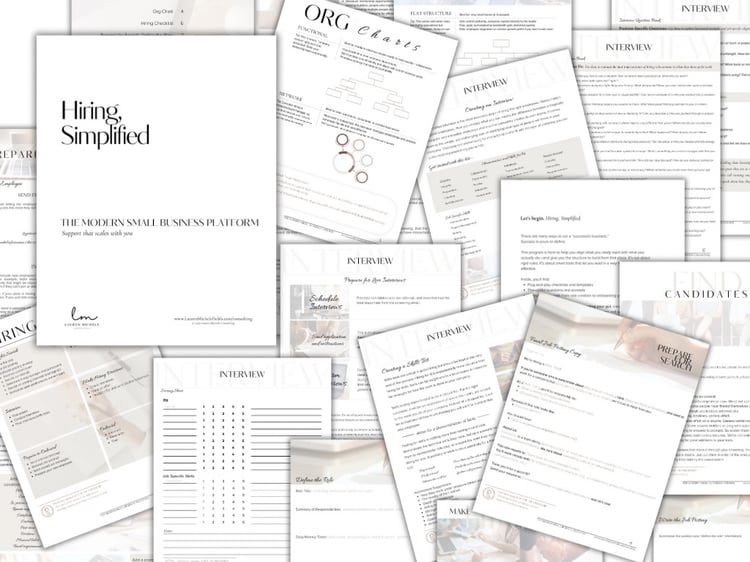
In Hiring, Simplified, I’ve outlined the steps moving from job acceptance through onboarding. Including the details that add up to a seamless start. Small, intentional effort matters here. But for really great onboarding (day 1 and beyond), all you need are three simple building blocks:
- Introduce: Start with the who. Let them meet the people, the personalities, and the energy of the place. Make sure they understand the core relationships, communication channels, and team dynamics. Pro Tip: If you have merch and tools for them, present it to them like a gift on their first day. Nothing is better than getting gifts and things already in your size or with passwords and logins already loaded?
- Familiarize: Then give them the why and where. What’s the history of this business? What do you stand for? What’s happening now, and where are you going? Where do they fit into that story? This is the culture handoff—consciously done.
- Train: Finally, the how. Show them how things work. Don’t just toss them the playbook—walk it with them. Let them practice. Let them ask. Let them build confidence before assuming ownership.
These three steps can happen in a day, a week, or over time depending on the role. But when you honor each one, you give your new hire (and yourself) the best possible foundation.
Want Help Defining Success Before You Hire?
That’s exactly what Hiring, Simplified was built to help you do. It’s a step-by-step, plug-and-play system designed to help you:
- Define success before you post the job.
- Create an interview process that actually works.
- Move through onboarding with ease and purpose.
In a simple, ready-to-use pdf.
Get Hiring, Simplified here.
Still unsure if it’s right for you? Get the FREE assessment tool. See where you’re solid and where you could use some help. Get the free pdf here.
 Lauren Michele Fields
Leave a comment