Most hiring advice tells you what to look for. This is about what to look past.
Interviewing is weird. Deeply, unavoidably weird. One of the strangest social situations we’ve invented for ourselves.
So, how do you find good candidates inside an environment where we are awkwardly performing for each other? Well, you ignore a bunch of stuff.
The Bias Trap: When Instinct Isn’t Instinct
If you’ve been following along, you know I talk a lot about energy, intuition, and instincts. They’re powerful, typically untapped superpowers we all have access to.
But can you define how those actually feel?
Because without full confidence in your intuition, you risk falling into the bias trap—a curated, conditioned set of beliefs that shape you without your awareness.
Left unexamined, bias will lead you into hiring loops that recreate the same problems over and over again.
Biases keep you stagnant and dull your potential for excellence.
This Shouldn’t Need Saying (But It Does)
First, you never judge candidates based on race, gender, ability, ethnicity, age, or anything inherently personal.
Period.
If that’s still a question, you’re not ready to lead a team.
Adapt the Role. Keep the Person.
Now let’s talk about things that might naturally trigger a reaction — but shouldn’t dictate your decision.
You may run across what initially looks like a roadblock. Don’t dismiss it at hello.
Imagine you find a candidate who is perfect in every way except one thing that doesn’t quite fit the role as written. Maybe their commute makes full-time in-person unrealistic. Maybe they’re exceptional at the most important part of the job but their admin skills need work.
Here’s what you don’t want to miss: you have more flexibility than you think. You are the business owner. You can adapt the role. And if you discount immediately, you haven’t solved any problems — you’ve just let a talented, high-fit person walk out the door.
I’ve seen roles adapted for great employees many times. No consequence to the business. Only upside.
Initial discounting will be your Achilles heel.
First impressions matter—but they aren’t everything.
Who they are to you isn’t the point.
It’s important to be brutally clear about who this person will actually interact with. If you’re hiring them but won’t spend much time with them day-to-day, how you personally “vibe” with them is irrelevant. Some of my best hires were people I’d never Sunday brunch with. But in the workplace? We were unstoppable.
You don’t need a team full of friends. You need a team full of people moving the mission forward. (Side note: if you’re relying on work to pull double duty on income and your only source of relationships, then we should chat—but I digress).
I’m not saying hire people who are awful. I’m pointing out that friend vibes and co-worker vibes don’t need to align here.
I don’t care if you went to rival schools, or you hate the way they say “instantaneously” too much. None of that matters.
Working with a team of people who are uniquely qualified and focused on the same goals is exponentially more enjoyable and valuable than a workplace clique. We’re looking for synergy—not matchmaking.
Chemistry: The Kind That Actually Matters
There is a kind of chemistry you’re looking for—but it’s not based on hobbies, humor, or shared backgrounds. It’s the energy of alignment. The way someone fits into the invisible current of how your company moves, thinks, and grows.
This is as important with two people as it is with two-hundred.
It’s real. But it’s rarely obvious. It’s something you sense underneath the surface noise.
Grade Nervousness on a Curve
Everyone is awkward in interviews. Everyone. Expect nervousness. Expect weird fidgeting. Expect sweat. Expect awkward greetings, bad jokes, talk about the weather, obvious comments about your office (or zoom background).
It doesn’t mean anything. And it’s not an indicator of what type of employee they’ll be.
These are candidates for your job, not improv actors.
They’re human beings trying to compress their whole existence into a 45-minute window to impress a stranger. Go in assuming you’re getting them at about 50%.
Give them grace.
Look deeper.
Even if they bomb.
You can tell if a person bombed because their fear took over. If you’re hiring to hold the nuclear codes—fine, disqualify. But if it’s most jobs, hold space to see how they recover.
My favorite interviews are the ones where something goes wrong or someone just gets in their own way. Why? Because the recovery is so important.
I have never had anyone perform perfectly, all of the time, in their role. They must recover. And if I can see that during the interview process—gold.
Listen Beyond What They Say
My favorite thing to ignore in interviews—what they actually say. Stay with me. Okay, I don’t totally ignore it, I listen. But what I really listen for is what they mean.
In interviews, people are guessing at the “right” answers. They’re trying to map their real selves into what they think you want to hear. You have to listen underneath that—for nuance, for spark, for realness.
Watch that you don’t project what you want them to say in these spaces. One trick? Simply reflect their words back to them. “What I heard you say was…” Give them a second chance to hear themselves and refine what they actually mean.
You’ll be amazed what comes out the second time. And they’ll be relieved.
Appearance: Truly the Last Thing That Matters
Ignore their appearance. Like fully. Ignore how trendy or outdated they look. Ignore their sense of personal style. What someone looks like is so unimportant to how they will perform in their role.
If appearance is important for your company’s client-facing standards, you’ll train that. If someone’s wrinkled suit is distracting you from their substance? That’s your bias to manage, not theirs.
If you’re challenging me on, “but what about professionalism?!” Then you’ve lost the plot. We’re not looking for the exception to prove the rule. Of course they need to show up in some sort of state. You’re not going to hire someone who has the judgement to show up in pajamas for a public facing job. But the difference between an ill fitting suit, outdated makeup, and maybe a little too much dog hair on that ugly polo—these are all things you can give instruction on.
Some of the best hires don’t look their best in interviews.
See Potential, Not Polish
At the end of the day, hiring isn’t about finding the “most impressive” resume. It’s about building a future. You’re hiring potential. The kind of potential that blooms in the environment you can provide.
You’re hiring someone whose instincts, energy, and baseline alignment fit into your company’s ecosystem. You’re hiring behaviors, attributes, and skills that perfectly align with the type of business and leader you are.
Anything else is just noise.
The kind of noise that will keep you from the best employees you’ll ever know.
The best hires often come wrapped in nerves, quirks, and imperfect, ill fitted trousers. Most people miss them because they’re too busy looking for polish.
You won’t.
You’ll know how to see them—and when you do, you’ll build a business no one can replicate.
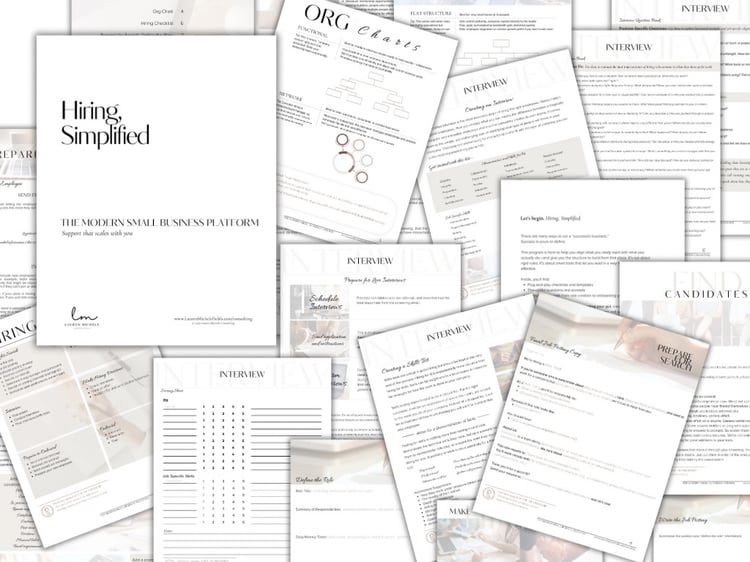
Find these strategies and more baked into Hiring, Simplified. A plug-and-play hiring system that filters for true fit, ends costly turnover, and frees you to build more than you ever imagined.
Start today.
 Lauren Michele Fields
Leave a comment