
We treat experience like it’s math. Years on paper. Roles on a resume. Metrics in a bullet list. But experience isn’t math. It’s a story. And like any story, you have to read between the lines to get the whole thing.
When you think about hiring someone with experience for your business…what are you actually asking for?
Generally, the more “experience” you demand, the less you plan to invest. That’s right. The higher you set the bar for experience, the more you’re really saying, “I don’t have the energy to teach this person anything.”
And listen—I get it. Hiring someone with experience might feel like a shortcut to solving your empty seat.
Whether you’re hiring your very first employee or you’ve already built a small team, chances are you’re already carrying too much. You’re tired. You’re stretched. You’re running the business and holding all the pieces together.
And when you finally decide to hire, it’s easy to believe the right person will just show up, plug in, and start running like they’ve been on your team for years. This is a trap.
If you’re looking for someone to save you, you’ve got the wrong perspective. And it’ll end up costing you more time, money, and heartache.
The Illusion of Experience
Experience feels safe.
When you write that job posting, it feels easy to say you want five years of this, or ten years of that. It feels like with each number you write, you’re guaranteeing your business a future level of performance. But experience is broad and might not actually be what you need.
So what actually is experience?
Is it time?
Is it accolades?
Is it success metrics?
None of those things actually tell you what you think they do.
Time doesn’t guarantee growth.
Someone can spend ten years doing the bare minimum, collecting a paycheck, and never actually getting better.
Accolades don’t guarantee talent.
Sometimes people win awards because they worked for the biggest brand, had the best resources, or benefited from timing and luck.
Metrics don’t guarantee ownership.
Sometimes those big numbers on a resume were team wins—or market wins—not individual ones.
Experience is just exposure. It’s what someone has already seen, already tried, already lived through. It tells you what they’ve survived, but it doesn’t tell you what they’re capable of becoming in your business.
I care less about who someone has been and much more about who they are about to be.
Experience, like art, is subjective.
It’s messy.
It’s flawed.
It’s human.
And just like art, some people look at it and see a mess. But you could see possibility. Because experience isn’t a guarantee. It’s just the starting point.
When Experience Does Matter
Of course, there are times when true, specific experience matters. If you need someone to build the IT infrastructure you have no business touching—you need an expert.
If you’re a creative founder who needs someone to run your financial systems—you need a specialist.
And if you’re scaling fast and you’ve outgrown your ability to manage all the details yourself,
you might need someone who’s done this exact thing before—in a business like yours,
so they can step in, take ownership, and run with it without needing your constant oversight.
That’s exactly the kind of role I unpack in my Align Your Business program—when you’re ready to hire “Superstars for Big Impact,” people who can hold real leadership without you having to hold their hand. That’s when required experience makes sense. When you can clearly define the gap they’re here to fill—and you know you can’t fill it yourself.
But unless that’s the moment you’re in? Preferred might be the door you actually need to open wider.
The Overlooked Power of Failed Experience
What about the candidate whose metrics look terrible? What about the person who barely lasted a year in a role similar to yours? What about the one who seems like a risky bet because they don’t check every box?
Most people toss those resumes straight into the “no” pile.
But here’s what I’ve learned:
Every poor performer is just a top performer waiting for the right environment.
Think about it. How many brilliant people have you known who were underutilized, poorly led, or stuck in a role that didn’t actually fit their strengths? Those are the people most leaders overlook. And those are the people who could become your biggest win.
But only if you’re willing to see past the paper and lean into a real conversation about what they learned and what they’re capable of next.
Related Experience vs. Unrelated Experience
What if someone has five years of experience—but only one of those years is in the exact role you’re hiring for? Do you dismiss them because the other four years don’t perfectly match? You shouldn’t.
Those four “unrelated” years still taught them something:
- Problem solving
- Collaboration
- Communication
- Learning how to learn
Someone who’s adapted to multiple roles might be a better hire than someone who’s been doing the same thing for ten years on autopilot.
Breadth is experience.
Depth is experience.
Both bring value—if you know how to look for it.
So What Do You Do With This?
Start by re-reading your job posting—especially the part about “required” experience.
Ask yourself:
- Am I using this requirement to protect myself from the work of developing someone?
- Am I raising the bar because I’m tired, not because the role actually demands it?
- Am I cutting off potential before it even has a chance to introduce itself?
And if the honest answer is yes—consider lowering the bar on requirements and raising the bar on your interviewing skills.
Say what you really want. Tell them you’re looking for someone ready to roll up their sleeves, or someone who’s eager to grow with you, or someone who’s not afraid to help you figure it out together.
It might feel vulnerable. But imagine how refreshing it would be to read a posting that actually tells the truth.
Because the right person? They aren’t just looking for a job. They’re looking for a place to belong, to build something real, and to become something bigger—with you.
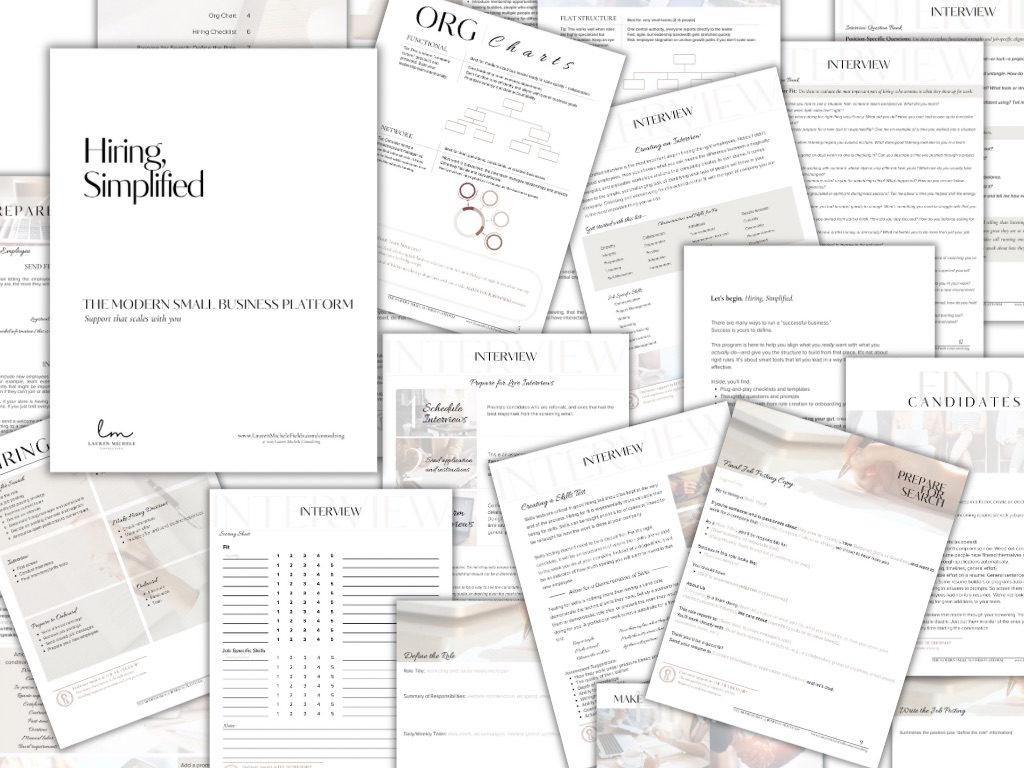
If you’re ready to build a hiring process that looks beyond the paper and finds the right fit—Hiring, Simplified gives you the framework to do it with intention.
 Lauren Michele Fields
Leave a comment